
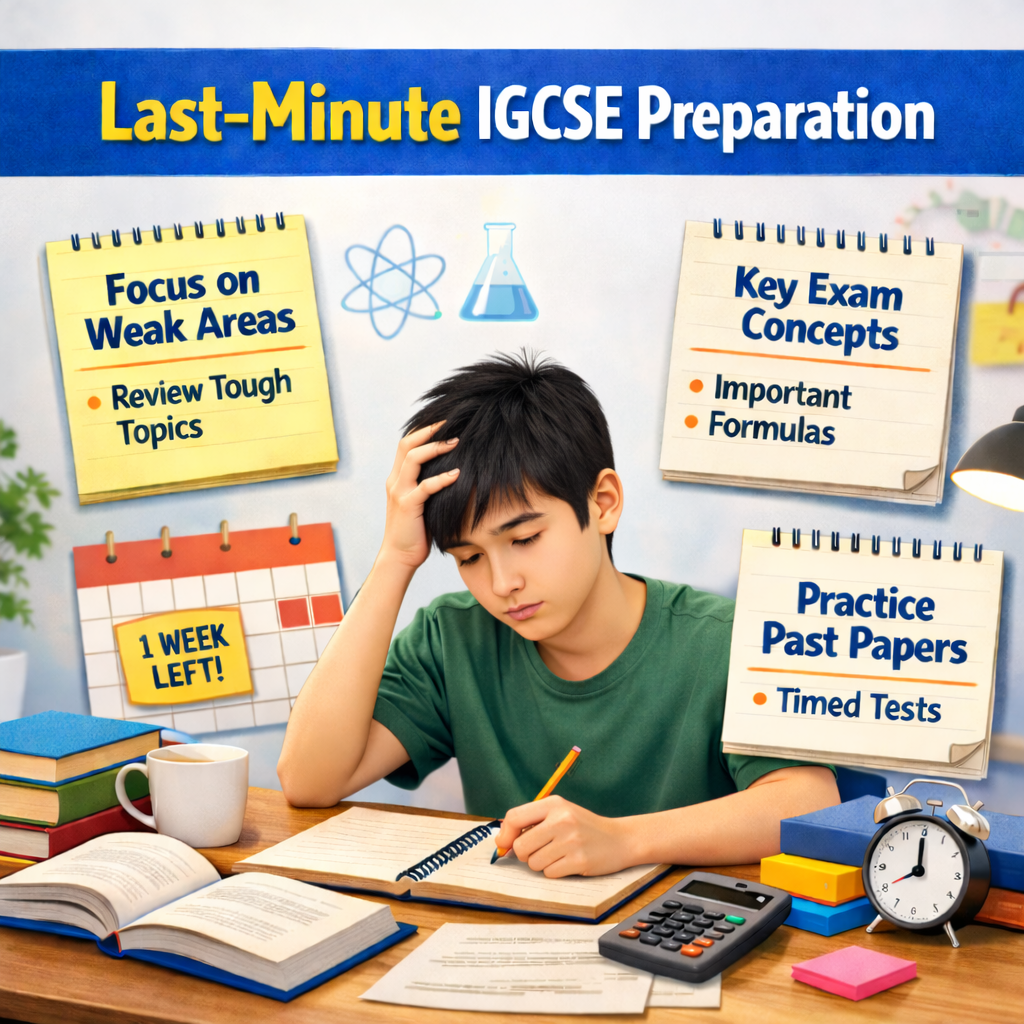
When exams are close, many students make the same mistake: they try to revise everything.
That sounds hardworking, but in reality, it usually leads to stress, shallow revision, and wasted time. In the final week before IGCSE exams, the goal is not to finish the whole syllabus again. The goal is to identify what matters most, focus on the topics most likely to improve your score, and use your remaining time wisely.
A smart final-week revision plan can still make a real difference. The key is to stop revising randomly and start prioritising strategically.
At My Protutor Educentre, we help students build focused revision plans based on exam sequence, subject difficulty, and scoring potential, so they can prepare with more clarity and confidence.
Tips 1: Why Smart Prioritisation Matters in the Final Week
Last-minute IGCSE revision is not about doing more. It is about doing the right things in the right order.
Students usually lose time in the final stretch because they:
- spend too long on topics they already know
- panic and jump from subject to subject
- reread notes passively instead of practising
- ignore the order of their actual exam timetable
The truth is simple: not every subject, topic, or chapter deserves equal time.
The smartest students do not always revise the most. They revise the most relevant things first.
Tips 2: Check Your Exam Timetable Before Planning Revision
Before creating any revision plan, check your official exam timetable here:
CIE exam timetable
AQA exam timetable
Edexcel exam timetable
This matters more than most students realise. Many revise based on mood or habit instead of urgency. That is a mistake.
Your revision order should follow:
- the subject with the earliest exam
- the paper where you are most likely to lose marks
- the topics with the highest scoring potential
If one paper is only a few days away while another is more than a week away, they should not receive equal revision time.
That is why timetable-first planning works better than balanced planning.
How to use the timetable to guide revision
Use this simple rule:
- revise the nearest paper first
- prioritise the weakest high-mark topics
- keep later subjects on lighter maintenance mode until they become urgent
This helps students avoid wasting energy on subjects that are not immediately critical.
For a broader timetable-based planning approach, you can also read our guide on IGCSE exam timetable and study planning
How to Prioritise IGCSE Topics in the Final Week
Once you know which paper is coming first, the next step is deciding what to revise first.
Do not revise in textbook order. That is inefficient when time is short.
Instead, rank topics using these three filters.
1. Exam date
Start with the subject or paper that comes first.
2. Mark potential
Prioritise topics that:
- appear frequently in past papers
- carry more marks
- often appear in structured or long-answer questions
3. Weakness level
Be honest. If a topic is weak and commonly tested, it should move straight to the top of your revision list.
This is where many students go wrong. They revise what feels comfortable instead of what is most urgent.
A Smarter 7-Day IGCSE Revision Plan
A good final-week study plan should be realistic, focused, and flexible.
Here is a practical structure students can follow.
Day 1 & 2 | Revise high-priority weak topics in the earliest exam subject. |
Day 3 & 4 | Do timed past paper practice for the next upcoming papers. |
Day 5 | Review mistakes, misunderstood concepts, and repeated weak areas. |
Day 6 | Revise key summaries, formulas, essay structures, and question patterns. |
Day 7 | Do light revision only. Focus on confidence, clarity, and rest. |
This works far better than trying to reread full textbooks in the last few days.
If you want a longer runway than one week, our article on how to prepare for IGCSE in 30 days is the natural next read.
Tips 3 :The Best Study Block Method for Last-Minute IGCSE Revision
A lot of students think long study hours automatically mean productive revision. That is not true.
A better method is to revise in focused study blocks.
The 3-part study block method
Each block should include:
40 minutes of focused topic revision
20 minutes of practice questions or one past paper section
10 minutes of mistake review and correction
This method works because it combines understanding, application, and reflection in one cycle.
Passive reading is not enough in the final week. Students need active recall and exam-style practice.
For more on using official practice material properly, see Mastering IGCSE Revision: Top Tips Using Specimen & Past Papers or Cambridge’s official past papers and teaching resources page
How to Revise Different IGCSE Subjects in the Final Week?
Different subjects need different revision methods. A generic approach is weak.
Mathematics: focus on questions, not notes
For Maths, improvement usually comes from practice.
Prioritise:
- algebra
- graphs
- mensuration
- probability
- formula application
- repeated past paper mistakes
If time is short, stop rewriting notes. Do more questions.
Science subjects: understand processes and question patterns
For Biology, Chemistry, and Physics, focus on:
- core concepts
- definitions
- labelled diagrams
- experiment questions
- data interpretation
- structured response mistakes
Science revision should be understanding-first, not memorisation-only.
English and languages: practise output
For language papers, focus on:
- paper format
- timing
- paragraph structure
- comprehension practice
- grammar correction
- summary and essay writing
Reading alone is not enough. Students need active writing practice.
Humanities and essay-based subjects: structure matters
For subjects like History, Geography, Business, and Economics, focus on:
- definitions
- case studies
- command words
- essay planning
- reusable explanation points
- strong introductions and conclusions
In many essay-based papers, structure can make a major difference to marks.
Tips 4: IGCSE Revision Checklist for the Final Week
Use this checklist every day to stay focused:
- Have I revised the most urgent subject first?
- Have I checked which exam is coming next?
- Have I revised my weakest high-mark topics?
- Have I completed at least one timed practice session today?
- Have I reviewed mistakes instead of just doing more questions?
- Have I revised formulas, definitions, or essay structures?
- Have I slept enough to stay mentally sharp?
A checklist like this helps students separate real progress from fake productivity.
Best Tips: Last-Minute Revision Tips That Actually Help
When time is tight, students need to cut the noise.
These are the most useful final-week habits:
Focus on likely exam topics | Do not spread yourself too thin trying to cover everything. |
Use summaries instead of rereading full chapters | Condensed notes are more useful than restarting the whole textbook. |
Review mistakes aggressively | Past mistakes often reveal exactly where marks are being lost. |
Use active recall | Close the book and test yourself. Recognition is not the same as remembering. |
Protect your sleep | Poor sleep reduces concentration, memory, and speed. Last-minute cramming at the expense of sleep is usually a bad trade. |
Best Exam Strategy to Maximise IGCSE Scores
Strong revision matters, but exam technique still matters too.
Many students know more than they manage to show because they panic, rush, or mismanage time.
Use this exam strategy:
- read the paper carefully before rushing in
- start with questions you can answer confidently
- avoid getting stuck too long on one section
- pace yourself against the clock
- leave a few minutes at the end to check your answers
A lot of marks are lost through preventable mistakes, not just lack of knowledge.
Need Help in the Final Stretch? Join Our 1-to-1 IGCSE Intensive Class
If your child is running out of time, struggling to prioritise topics, or feeling overwhelmed before the exam, a last-minute intensive class can help bring structure and clarity fast.
At My Protutor Educentre, our 1-to-1 IGCSE intensive classes are designed for students who need focused support before the exam.
Students get:
- personalised topic prioritisation
- targeted revision for weak areas
- past paper guidance
- exam strategy coaching
- focused support based on their actual exam sequence
This is especially useful for students who know they cannot afford to waste their final week revising blindly.
Looking for focused last-minute support?
Group revision can help with motivation, but last-minute preparation usually needs precision.
A 1-to-1 intensive class allows the tutor to:
- identify weak areas quickly
- focus only on the most important topics
- adjust the lesson based on the student’s pace
- teach exam technique directly
- help students avoid wasting time on low-priority content
In the final week, personalised support is often far more effective than general revision.
Need a fast, focused revision plan?
Read more about our expert IGCSE exam preparation support and why students choose MyProTutor
Frequently Asked Questions
1. How do I know which IGCSE topics to revise first?
Start with the subject that comes first on your exam timetable, then prioritise high-mark topics and your weakest areas.
2. Should I revise by subject or by exam date?
In the final week, students should revise mainly by exam date. The nearest paper should usually get the most attention first.
3. Is it better to do past papers or reread notes before IGCSE exams?
In the last week, targeted past paper practice is usually more effective than rereading large amounts of notes.
4. Can I still improve in one week before IGCSE exams?
Yes. A focused revision plan can still improve performance, especially when students stop trying to revise everything and prioritise strategically.
5. What should I do the night before an IGCSE exam?
Do light revision only. Review formulas, key facts, essay structures, and common mistakes. Avoid heavy cramming.
6. Can tutoring still help close to the exam?
Yes. One-to-one tutoring can help students identify weak areas quickly and focus on the topics most likely to improve results.
Final Thoughts: Revise Smarter, Not Wider
Last-minute IGCSE preparation does not have to mean panic.
Students usually struggle most when they revise without a plan, spread themselves too thin, and waste energy on low-priority topics. A better approach is to use the exam timetable, rank topics honestly, and focus on the subjects and question types most likely to improve results.
The final week is not the time to do everything. It is the time to do the right things in the right order.
If you want structured support, focused revision planning, and one-to-one help for the final stretch, My Protutor Educentre is here to help.
Ready to prepare smarter with a 1-to-1 IGCSE intensive class?
Enquire with My Protutor Educentre today